From traditional bhajans to film soundtracks, devotional albums, independent releases, reels and contemporary reinterpretations, Hanuman-inspired music has an extraordinary ability to travel across generations. It can be devotional, cinematic or meditative; at other times, it sounds almost like an anthem.
Why do so many Hanuman songs find lasting audiences? Devotion gives listeners an immediate connection, while memorable phrases, rhythm and repetition make the music easy to sing and share. The Hanuman Chalisa can move from a quiet personal recitation to a collective chorus without losing its identity.
That is only part of the story. Indian musical tradition also remembered Āñjaneya, or Hanuman, among earlier authorities on music. This historical association does not explain every modern hit, but it offers a deeper way to hear the bond between Hanuman, devotion and sound.
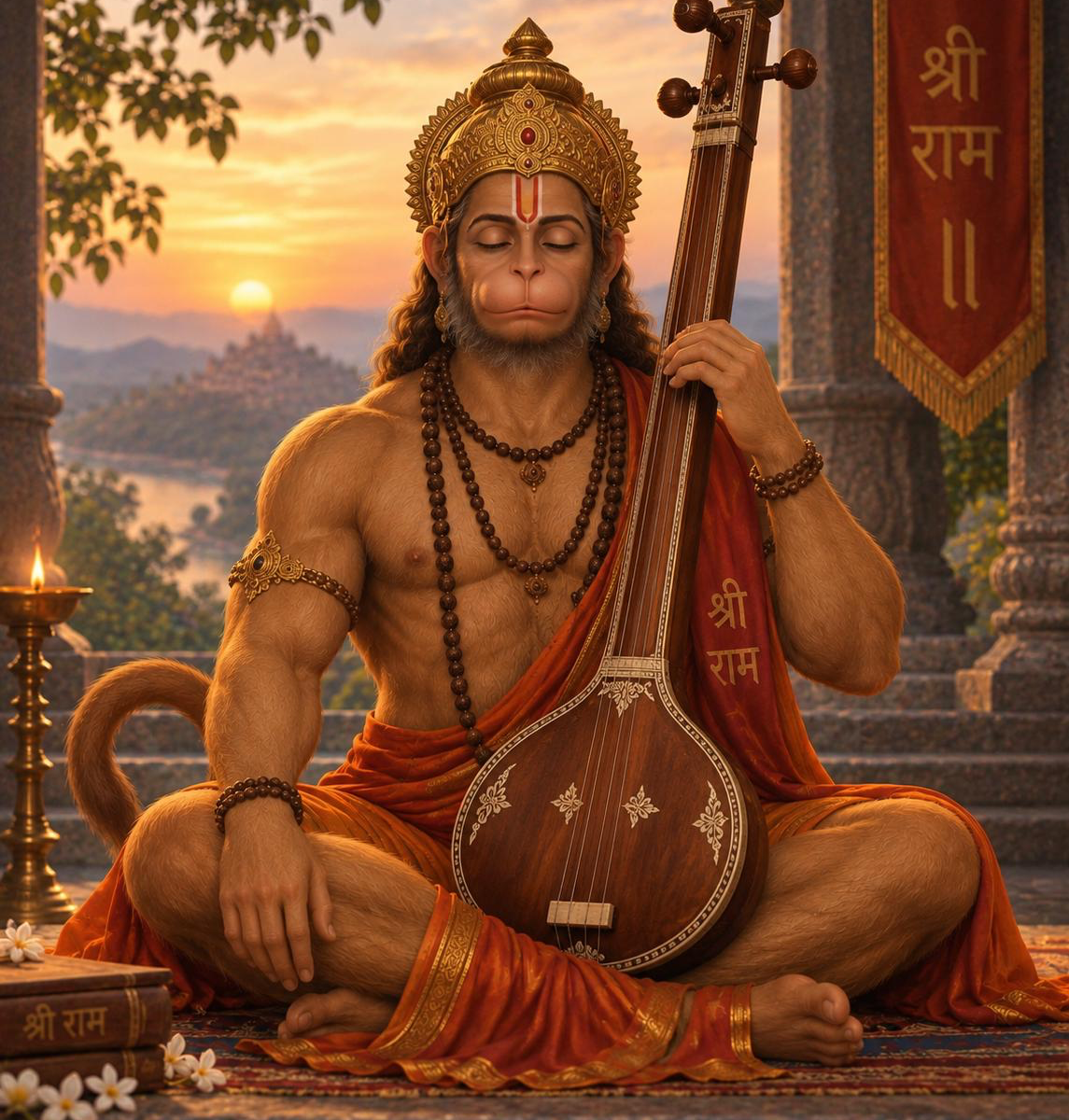
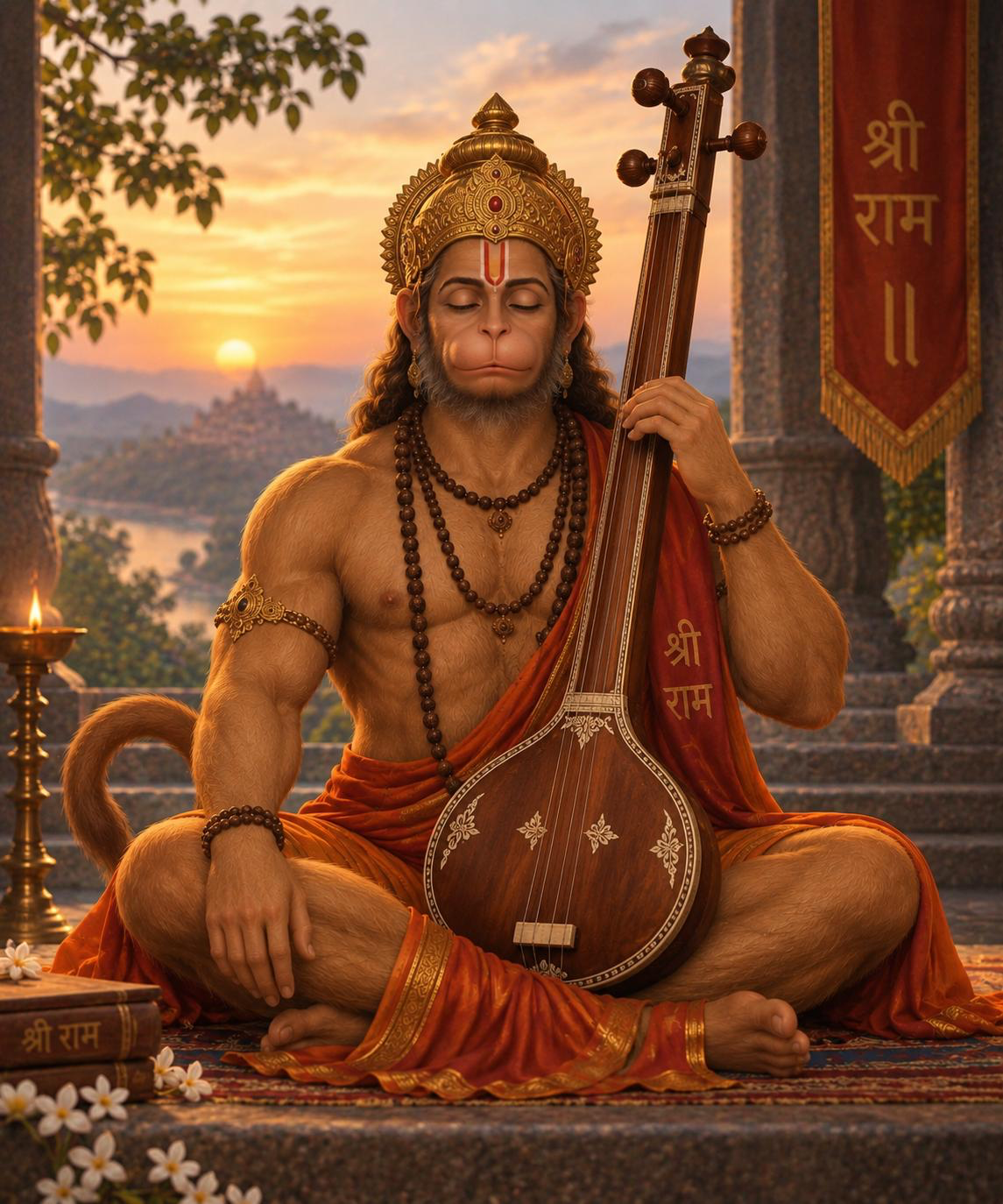
Hanuman, imagined at the meeting point of devotion and music.
Why Hanuman Songs Connect Through Rhythm and Chant
Before looking at history, listen to what many successful Hanuman compositions actually do. They bring together rhythm, repetition, build-up, collective singing and powerful syllables to create a rising sense of energy. Even when two songs belong to completely different musical worlds, they can produce a similar physical response: a quiet invocation grows ecstatic, a chorus turns into a chant, and the chant gathers collective momentum.
That makes Hanuman particularly interesting for a composer. He embodies strength and surrender, power and humility, movement and meditation, heroism and devotion. This gives a composer an enormous canvas, from a delicate classical phrase to hundreds of voices chanting together. Both can feel authentic.
Hanuman in Indian Music History
Go back into Sanskrit musicological literature and the connection becomes considerably more interesting. The musicological tradition surrounding works such as the Saṅgīta Ratnākara remembers earlier authorities on music. Among names associated with India’s ancient musical knowledge appears Āñjaneya — Hanuman.
This does not mean that historians can prove that the Hanuman of the Ramayana literally sat down and authored the surviving treatises attributed to him. Many early works are lost, authorship traditions developed over centuries, and those distinctions matter. But culturally, something important had clearly happened. Indian civilisation remembered Hanuman as belonging inside the world of music. He appears not merely as its subject but, in some traditions, as one of its authorities.
Tyagaraja, Hanuman and the Bliss of Music
Now come several centuries forward. Saint Tyagaraja — one of the foundational figures of Carnatic music — gives us perhaps the most beautiful bridge between these worlds. In his composition “Gītārthamu Saṅgītānandamu” in Surati, Tyagaraja brings together spiritual understanding, musical bliss and Hanuman — Vātātmaja, the son of Vāyu. Hanuman is presented as one who understands something profound about both spiritual truth and the experience of saṅgīta. And suddenly the connection begins to feel less accidental.
For Tyagaraja, music and Rama-bhakti are inseparable. And who represents Rama-bhakti more completely than Hanuman? Perhaps this is why Hanuman sits so naturally at the intersection of Rama, bhakti, nāda and saṅgīta.
Why Hanuman Music Works for Modern Listeners
Today, a Hanuman track arrives with something most new compositions spend enormous effort trying to create: a powerful emotional archetype. Listeners already know the character, who evokes courage, protection, energy and devotion. He also embodies complete surrender without weakness. A composer therefore begins with centuries of cultural memory rather than an unfamiliar emotional world.
Rhythm and repetition then give that memory a shape listeners can join. A repeated name becomes a hook, a mantra becomes a refrain, and a chorus sung by thousands becomes a shared experience. Contemporary producers might call this memorability and audience participation. Indian devotional traditions have worked with those musical principles for centuries.
Public listening figures show this reach, though no two uploads can represent the whole tradition. As of 3 October 2026, T-Series Bhakti Sagar’s Shree Hanuman Chalisa with Hariharan had about 5.77 billion YouTube views, while its Bajrang Baan had about 324 million. This small sample spans at least five languages: Hindi, Telugu, Marathi, Bengali and Malayalam. Each of the linked regional recordings has millions of views. These are views of individual uploads, not unique listeners or a combined streaming total.
Why the Hanuman Chalisa Adapts to New Musical Styles
This may also explain why the Hanuman Chalisa survives so many musical treatments. It can be sung traditionally or shaped into classical, meditative, orchestral, cinematic or percussion-heavy contemporary music without losing its identity. Few pieces of text possess that kind of musical elasticity.
Part of the reason is structural: recurring sounds, rhythmic phrasing and familiar textual anchors give composers enormous room to reinterpret the material while listeners retain instant recognition. That combination of familiarity, repetition, emotional meaning and musical reinvention is powerful. It is almost the perfect recipe for music that travels.
A Musical Connection Across Generations
We often say Hanuman is enormously popular, and therefore songs about Hanuman become popular. That is certainly part of the explanation. But India’s musical history invites another perspective. Perhaps Hanuman and music were never separate ideas in the first place.
The tradition remembers an Āñjaneya connected with musical knowledge. Tyagaraja connects Hanuman with the experience of saṅgītānanda — the bliss of music. And centuries later, composers continue discovering that Hanuman translates extraordinarily well into rhythm, melody, chant and mass musical energy. Perhaps that continuity is part of the reason these songs still resonate.
From Nāda to the Modern Playlist
There is something wonderfully circular about the story. An ancient tradition remembers Hanuman as a musical authority. A saint-composer sees him through the world of saṅgīta and Rama-bhakti. Generations sing his name. Recording technology transforms those songs into records and cassettes. Cinema transforms them into soundtracks. Streaming transforms them into playlists. And social media introduces the same musical energy to another generation.
The production, instruments and audiences change, but Hanuman remains. The deeper question may be why he has remained such a powerful musical idea for so many centuries. Somewhere between mythology, musicology, bhakti and today’s recording studio, we may find the answer: Indian tradition remembers him as part of its musical story.
Historical references and a necessary distinction
The historical framework for this article draws on the Saṅgīta Ratnākara’s reference to Āñjaneya among earlier musical authorities and on Saint Tyagaraja’s composition “Gītārthamu Saṅgītānandamu.”
These sources should be understood with an important distinction: they demonstrate that Indian literary and musicological traditions associated Hanuman/Āñjaneya with music and musical authority. They do not establish, in the modern historical sense, that the Hanuman of the Ramayana can be proven to have personally authored surviving musicological works.